
Hydraulic Breaker Types: Box vs Top vs Side Type Hydraulic Breaker – Full Comparison (Complete Engineering Guide)
What Are the Differences Between Box-Type, Top-Type and Side-Type Hydraulic Breakers?
Choosing the right hydraulic breaker is not about picking the “strongest” option—it’s about selecting the most stable, cost-effective solution for your working conditions. An incorrectly matched hydraulic breaker can reduce efficiency by 30% and double maintenance costs.
This engineering guide, according to an engineer with 20 years of experience in the construction engineering machinery industry, will thoroughly break down the performance, selection, installation, and maintenance of side-type, top-type, and box-type hydraulic breakers from three aspects—pre-sales selection, in-sales installation, and after-sales maintenance—combining scenarios such as factory workshops, mines, and demolition sites, to introduce their differences in detail.
Now, across real-world applications like mining, demolition, tunnelling, and urban construction, getting the right hydraulic breaker for your excavators.
I. Structural & Appearance Differences
In the excavator attachments industry, hydraulic breaker types are usually classified according to their shell structure (mounting method):
Box-Type Hydraulic Breaker (Silent Type)
The hydraulic breaker core (cylinder block, valve group, nitrogen chamber) is completely enclosed in a fully sealed high-strength 20CrMo steel cast or welded housing, and the transverse clamp bolts are also not exposed. It has a seamless and boxy appearance, like a “one-piece armour”. But its most important advantages are dustproofing, low noise and vibration, and compatibility with urban construction needs, and its failure rate is relatively low because the core is well protected.
Top-Type Hydraulic Breaker (Open Type)
A variant of the “box-type hydraulic breakers”, with the mounting point also on the top of the excavator breaker. In terms of appearance, vertical through bolts run from top to bottom, and transverse clamp bolts are visible on the sides. Therefore, the power cell’s protection is weaker than that of box-type hydraulic breakers. However, it has a larger operating radius and a better force transmission, making it more suitable for vertical operations, mining, and quarrying.
Side-Type Hydraulic Breaker (Triangular Type)
A side-mounted triangular-type housing usually consists of two thick 20CrMo steel side plates on each side of the core, clamped together by transverse bolts. The most obvious feature is triangular steel plates with bolt heads on both sides—commonly known as the “triangle breaker.” Because of its side-mounted points on the hydraulic breaker, it offers a low mounting position and easy maintenance; however, it has a limited vertical working range.
II. Core Performance Comparison
Structural Strength & Durability
Side-Type
Weak. Open and compact structure with lightweight. The two side plates are held in place by only a few bolts. Under lateral loads (e.g., when the excavator strikes at an offset angle), it deforms • bolts easily loosen → housing misaligns → piston/cylinder block scoring. However, due to its low mounting point, it offers certain flexibility advantages at specific angles or in situations that require a larger operating radius.
Top-Type
Medium. Vertical through locking bolts + semi-enclosed structure, with better lateral impact resistance than Side-Type. However, during long-term hard-material breaking operations (such as granite, concrete, or frozen soil), fatigue cracks may occur at the connection between the upper and lower shells.
Box-Type
Strongest. Fully enclosed box structure, with the most stable lateral rigidity and torsion resistance. The internal cylinder block is less affected by external forces, and its impact frequency and single-impact force are the most stable. Ideal for: tunnel excavation, secondary breaking, building demolition (steel bars may jam the chisel).
Impact Performance Stability
Operating Efficiency
Side-Type
Adopting an open, compact structure with a lightweight design, the core is directly exposed between the two side plates. Once the bolts are loose, vibration transmission is relatively direct, and the shock wave “leaks” from the cylinder block to the shell, resulting in energy loss and shortened drill rod life.
Open Type
Vertical clamping force is more uniform. The cylinder block loading is more force-coaxial. The impact energy transmission efficiency is higher. It is especially suitable for large-scale hydraulic breakers (tool diameter ≥140mm), and the energy utilisation rate is about 5-8% higher than that of the side type.
Box Type
Due to the fully enclosed shell that performs the functions of “protection” and “shock absorption”, the overall weight of the box-type hydraulic breaker of the same class is usually heavier than that of the open-type and side-mounted-type hydraulic breakers. This requires the excavator to have better balance. Still, during high-intensity continuous striking, increased self-weight also improves the single-impact force and impact efficiency.
Measured: Under the same hydraulic flow and tool diameter, the box-type hydraulic breaker shows the smallest fluctuation in blows per minute.
Noise & Vibration (Critical for Compliance)
Side Type
High noise. The shell acts like a drum, radiating impact noise directly, and vibration travels to the excavator boom. A >140mm side-type excavator breaker hammering concrete for 3 hours will make the operator’s hands numb.
Open Type
Medium. The top-type hydraulic breaker is equipped with rubber shock-absorbing pads between the shell and the cylinder block, resulting in noise 10-15 dB lower than that of the side-type breaker.
Box-Type
Optimal. The power cell is completely enclosed in a fully sealed box shell. The interior of the thick box shell is usually filled with polyurethane damping and buffering materials to absorb high-frequency vibration, effectively reducing vibration transmission and working noise. That’s why silent-type hydraulic breakers often have a fully enclosed appearance. Therefore, box-type hydraulic breakers are ideal for construction in noise-sensitive areas (such as urban residential areas and areas near hospitals).
Maintenance Complexity –The Key Part Most Business Owners Care About
Side Type
Simplest and lowest cost. Open design with exposed power cell, which is more vulnerable to external impact or debris intrusion in harsh environments. However, maintenance personnel can easily access the core components for daily checks, oil injection, and replacement of vulnerable parts, such as seals, tight bolts, and the front bushing. In addition, the spare parts are also relatively cheaper.
Open Type
Medium. Disassembly and maintenance require specialised tools for vertical through-bolts. Ordinary mechanics are likely to install them improperly, leading to oil leaks. However, common models are readily available with spare parts.
Box-Type
Most complex and expensive. Although the fully enclosed shell structure can provide physical protection for the internal power core, preventing dust, mud, and gravel from entering key components, reducing failure rates, and extending the service life of hydraulic breakers, daily maintenance and greasing still need to be performed through dedicated inspection holes. If in-depth core disassembly and repair are required, the entire shell must be removed, which is a relatively cumbersome process. Therefore, the maintenance difficulty and cost are higher than those of other types. Moreover, once the box housing is deformed, it is almost impossible to correct, and it can only be changed by changing the assembly.
III. Pre-Sales Selection Guide (Most Important Section)
Side Type
Pros
Among the three types of hydraulic breakers, the side type is the least expensive, usually priced at 1/2 to 2/3 of a box-type excavator hammer. The first choice for side-mounted triangular-type hydraulic breakers is for tight budgets and cost performance. Absolutely budget-friendly, best value. Lightweight, suitable for small-tonnage excavators’ demolition operations, especially soft rock (shale, weathered rock) demolition and old foundation removal projects with no harsh requirements on work efficiency, such as road breaking, house demolition, ruins cleaning, and rock foundation excavation.
Cons
Eccentric wear of chisel tools and bushings is a common problem. When subjected to lateral force (such as during building demolition or concrete breaking with rebar), the two side plates will misalign like a “sandwich biscuit”, leading to piston scratches and chisel breakage. So, never use side-mounted triangular-type excavator hydraulic breakers on hard rock (granite) or deep excavation operations.
Top-Type
Pros
Mainstream choice. It combines the cost of the side-mounted type with the performance and durability advantages of the box-type hydraulic breakers. The top-type excavator breaker has better force transmission and a lateral force-bearing capacity about 1.5 times that of side-type breakers. Suitable for medium-sized demolition enterprises with 15-30 ton excavators for foundation pit rocks, road breaking, mine stripping, quarries, and other conventional operations.
Cons
“Top-heavy”. Heavy top housing, and the bottom is open. So, the front cylinder block is prone to dust ingress, which can damage the oil seal. It is inconvenient to adjust the striking angle in narrow spaces (such as secondary crushing, tunnels).
Box-Type
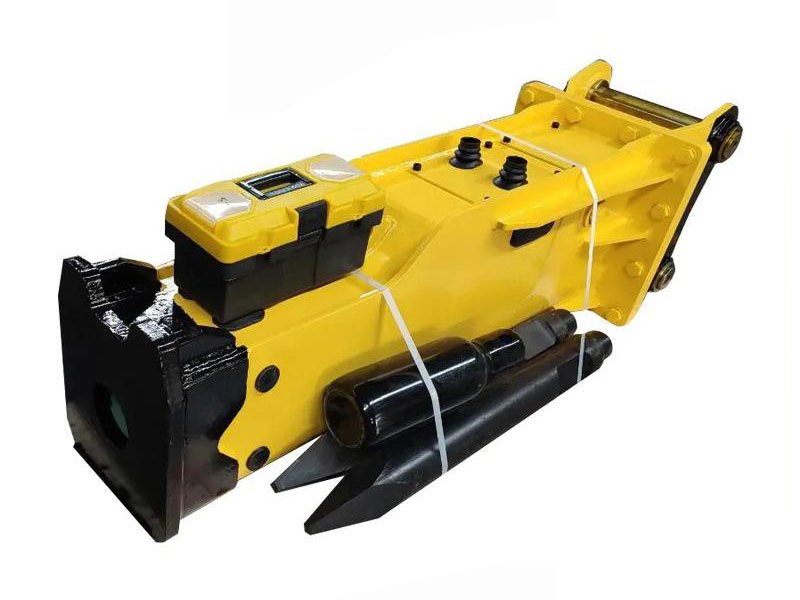
Pros
Unmatched rigidity. The housing is closely attached to the cylinder block, which can withstand huge lateral impact. The service life of the chisel tool is also more than 30% longer than the other two types of hydraulic breakers. Besides, it can ensure accurate vertical striking, with little deviation. Suitable for high-demand working conditions—tunnel invert excavation (extremely large lateral force), construction in urban core areas, projects requiring low noise, and large excavators (≥40t).
Cons
Expensive, complicated maintenance. The self-weight is 30% higher than that of the same-level models. Still, it will significantly reduce the excavator’s lifting capacity and moving speed.
Note: Used box-type hydraulic breakers are not recommended. At the same time, the excavator must be equipped with a reinforced arm and slewing bearing. Otherwise, the hydraulic breaker survives, but the excavator falls apart first.
IV. Installation Insights (Often Overlooked)
Side-Type Hydraulic Breaker
Pros: Extremely convenient installation. Due to the open-clamp structure, the hose connector’s position is flexible. Because of the side-mounting point, it can be mounted in 10 minutes and causes minimal wear on the excavator arm.
Cons: Easy to wear and abrasion-resistant. Many factories skip installing vibration dampers to save costs, resulting in direct hard contact between the side plates and the power core, which tears the lugs on both sides within a few months. In addition, the transverse clamp bolts are exposed, and their tightness must be checked every 20 working hours.
Top-Type Hydraulic Breaker
Pros: Standard installation. The housing is equipped with positioning pins, which are not easy to misalign.
Cons: High risk of interference. After installation, the machine must be tested to ensure it does not contact the cab or track within the slewing radius. In addition, the top-type hydraulic breaker requires higher hose back pressure (Pay Attention to the cleanliness of the return oil filter element).
Box-Type Hydraulic Breaker
Pros: Perfect match. High-end box-type hydraulic breakers are equipped with special flow-control valve blocks and pipeline accumulators, which help protect the excavator’s main pump.
Cons: The box-type hydraulic breaker has the highest precision requirement for the distance between the suspension pin holes and also imposes certain technical requirements on installers. Heavy self-weight requires longer, thicker pins during installation. If the positioning pins are misaligned, hammering them in forcefully can cause microcracks in the cylinder block. Therefore, 80% of repair shops lack the capacity to install box-type hydraulic breakers.
V. After-Sales Failure Analysis
- Side-Type: Usual faults – side plate cracks, bolt breakage, housing shifting, causing piston scratches. Cost-saving counter measures: Replace side plates and high-strength bolts in time (grade 12.9, not 8.8).
- Top-Type: Common faults – oil leakage at the joint between the upper housing and the middle cylinder block. Countermeasures: Check vertical bolt torque every 500 hours and apply high-temperature anti-seize agent when replacing the O-rings.
- Box-Type: Normal faults – debris (chisel’s wear powder, rust) accumulates inside the housing and cannot escape, causing buffer piston jamming. Measures: The box-type hydraulic breakers must be regularly purged internally with compressed air via exhaust ports. It is also recommended to perform an “open-box dust cleaning” on box-type hydraulic breakers that are over 3 years old.
VI. Final Summary (Decision Framework)
- Side-Type: Cheap and easy to repair, but prone to loosening and misalignment, suitable for light to medium breaking operations.
- Top-Type: Rugged and balanced – mainstream choice, suitable for mines, quarries, and demolition.
- Box-Type: Silent and tough, but finicky, costly, and difficult to maintain – built for extreme working conditions and noise-regulated areas.
Most important: Don’t just look at the hydraulic breaker structure, but also the excavator’s condition and the hydraulic breaker’s quality.
A leaking, low-pressure excavator won’t deliver a strong impact force, even when equipped with the best box-type hydraulic breaker. With a well-maintained excavator paired with our side-type hydraulic breaker, it is not uncommon to use it for 3 years without problems.
For friends who are not sure about specific models, failure issues, or specific working conditions, please get in touch with our sales team. Of course, it is best to provide your excavator brand/model (e.g., XCMG 135) and the breaking material (limestone/granite/concrete/frozen soil). Our engineers will promptly recommend the optimal solution.
Next topic: “How to Identify Fake VS. Real Accumulators.” Stay tuned!